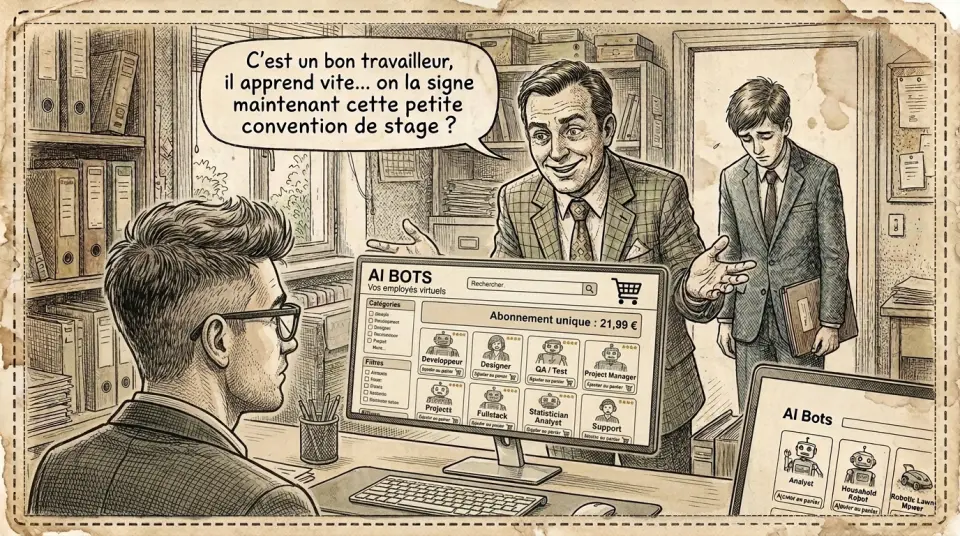
The arrival of AI triggers anxiety: much like the Internet and the personal computer in their day, it accelerates the transformation of our working environments and deeply questions the purpose of human contribution.
While it will inevitably eliminate certain jobs—by executing tasks with formidable efficiency and minimal error rates—it also compels us to rethink our societal trajectories and gives rise to new activities. The history of innovation shows that major breakthroughs never merely replace a manual action: they force us to step up, reconfigure our organizations, and strive for efficiency.
First, like any decisive leap forward, innovation drives us to develop higher intellectual skills, pursue further learning, and broaden our thinking. This is precisely what writing did (c. 3300 BC): by externalizing human memory, it gave birth to bureaucracy, scribes, accounting, and the earliest legal codes. Working no longer meant merely manipulating matter, but manipulating symbols.
Next, it serves as the essential prerequisite for unprecedented collective organization. This was the role played by the mechanical clock (14th century): as the cornerstone of modern industry, it substituted abstract, linear, and commodified time ("time is money") for the natural rhythm of the seasons and the sun. Without this rigorous synchronization, neither factories, nor office hours, nor global logistics could have ever emerged.
Finally, technological leaps drastically optimize resource utilization and multiply the value generated for any given expenditure. The standardized intermodal shipping container (Malcolm McLean, 1956) illustrates this brilliantly: a simple standardized 20- or 40-foot steel box eliminated manual dock handling, cut freight costs fiftyfold, and orchestrated the international division of labor.
Even if each of these shifts sometimes triggered other medium-term imbalances, we are only at the dawn of AI: there is far more to expect from it than the mere automation of administrative forms.
Regaining Control: From Craftsmanship to Tool-Assisted Steering
During my early days with generative AI, faced with early-stage waste, coding sessions overwritten by fresh generations, and commits scrapped due to a lack of technical consistency, I quickly felt the need to regain control. I therefore framed my development process: a roadmap tracking precise task-by-task progress, contextualized Markdown documentation for every task, rigorous technical specifications, and strict guideline files (firm architectural decisions, mandatory or banned stacks, rigorous unit/functional testing protocols, and systematic documentation updates).
With the rise of multi-agent software engineering frameworks—such as BMAD (Breakthrough Method of Agile AI-Driven Development), or equivalent initiatives like ChatDev, MetaGPT, CrewAI, or AutoGen—we operate at a different scale: work is organized within a genuinely hybrid team blending humans and specialized agents.
How does it work? It builds upon traditional V-model project governance (framing, workshops, functional and technical specifications, acceptance testing, coding, integration, validation), while injecting modern agile practices (Scrum, pair programming). Roles are then distributed according to each participant's strengths. In my web game project, I have defined 6 bot agent roles and 3 human roles:
| Entity | Role | Mission / Responsibility | Value Added: Agent vs. Human (or vice versa) |
|---|---|---|---|
| Bot | Product Manager / PO | Structuring epics, user stories, acceptance criteria | Instant comprehensiveness, consistent dependency tracking without contextual blind spots |
| Bot | UX Designer | Screen user flows, textual wireframes, journey ergonomics | Instant exploration of alternatives, scrupulous compliance with design standards |
| Bot | Analyst / Architect | Data modeling, API contracts, technical constraints | Broad high-level perspective without cognitive fatigue, strict application of design patterns |
| Bot | Frontend Developer | Component integration, UI, state management binding | Raw velocity, on-the-fly boilerplate generation, zero syntax typos |
| Bot | Backend Developer | Business logic, endpoints, persistence, security | Rapid implementation, uncompromising rigor regarding typing and contracts |
| Bot | QA / Test Architect | Test planning, drafting unit and functional tests | Exhaustive test coverage without fatigue, systematic regression hunting |
| Human | Project Director | Core substance control, strategic vision alignment, milestone sign-off | Critical judgment, strategic intuition, final trade-offs and decision-making |
| Human | Level Designer | Balancing rules, game design intent, core input data | Gameplay sensitivity, player feel, and engaging game experience |
| Human | Graphic / Video Artist | Visual asset creation (assisted by image/video generation bots) | Art direction, stylistic coherence, emotion, and artistic sensibility |
The entire team operates within this assisted framework: each contributor steps in at the right moment, once upstream prerequisites are validated. The advantage of BMAD and similar frameworks lies in offering ready-to-use roles, prompts, and rituals, sometimes supplemented by specialized modules (such as Game Design Development modules to handle GDDs and asset production). Naturally, the human retains full control to adapt the framework to project constraints.
While it is still early to measure the exact return on investment, realistic projections anticipate a 3x to 10x acceleration, along with vastly clearer traceability between production tasks and strategic decisions.
The Frugality Challenge: Designing with Discernment
This momentum nonetheless raises serious challenges: security, private data exposure, and, above all, escalating energy and hardware consumption.
This is precisely where our human brainpower—having just reclaimed precious time thanks to bots—must step up: by embedding eco-design and digital sobriety right into our architectural foundations. Designing lean, efficient systems must no longer be an afterthought, but the primary criterion of our technical choices. This begins by questioning our actual needs: is multiplying pie charts and complex cross-tabulations in a Power BI report truly relevant, when two or three targeted, well-thought-out indicators perfectly serve daily decision-making?
This pursuit of energy and material efficiency has always characterized the most enduring breakthroughs:
- Lighting (from candles to LEDs): a modern LED bulb consumes roughly 90% less energy than an incandescent bulb for the same luminous flux, and hundreds of times less than the flame of a candle or oil lamp.
- Thermal insulation and heat pumps: a modern heat pump delivers 3 to 4 kWh of heat for every 1 kWh of electricity consumed, whereas an old open fireplace let 85% of its heat escape up the chimney.
The role of hybrid teams will undoubtedly be to harness the acceleration offered by machines not to produce superfluous code, but to build better-controlled, frugal, and genuinely valuable solutions.