I would have loved to see these often tedious documents relegated to relics of the past. Yet, it is reassuring to realize that structuring and steering your work remains essential to achieve the desired outcome. AI will not exempt us from producing the foundational assets needed to frame our thinking and formalize project decisions.
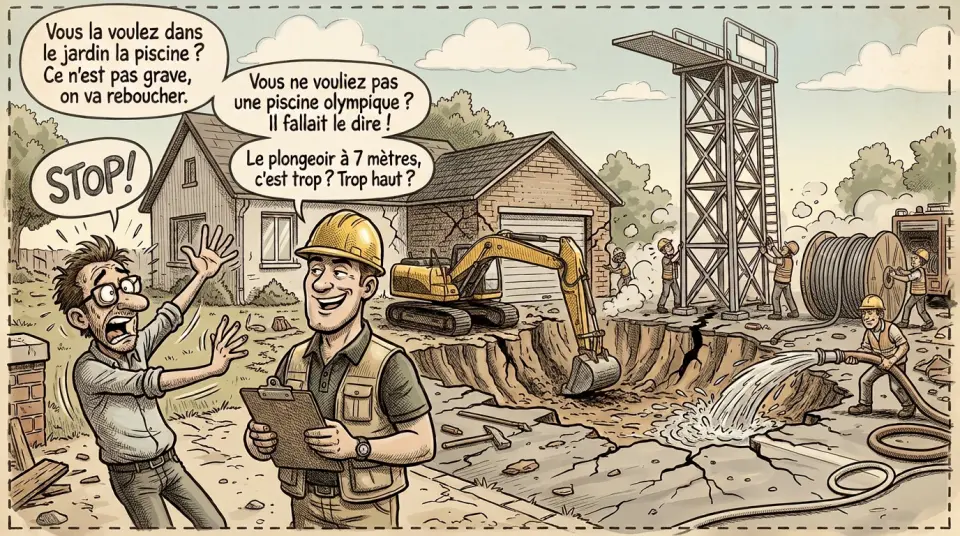
I once knew a building contractor who was always rushing to close out his jobsites under the pretense that "time is money." But pouring a concrete slab, drilling through a wall, or digging an excavator trench in haste often undermines the end result. Stakeholders must align on the objective before breaking ground.
AI has an inherent bias: it rarely prompts us to ensure it truly meets our expectations. It simply consumes our prompts, retrieves patterns closest to the raised issues, scans the web for similar problems, and, through all this, delivers the best possible guess within its reach ("best effort"). Why? Quite simply because it fears nothing: making poor choices, generating inconsistent output, falling short of our expectations, or having to shoulder the judgment and fallout of a botched job...
Fair Enough, but We Can Tweak the Prompt a Hundred Times
One might think this is trivial and that repeatedly nudging the model until satisfied is enough—leveraging its speed to bypass demanding preparatory work.
However, outsourcing project scoping and documentation to trial-and-error runs into two major objections:
Resource Consumption: AI relies on substantial compute and is not infinite. Multiplying iterations out of definitional laziness risks hitting resource bottlenecks on complex topics. Industrial history illustrates this well: in the 1950s at Toyota, Taiichi Ohno replaced the "push system" (blind overproduction) with the Kanban system and a "pull system" (producing strictly on demand). This mindset proves that an upstream framework optimizes both yield and quality.
Intellectual Stagnation: AI feeds on the collective memory of the internet. If we stop producing original analysis, it risks churning out redundant, zero-value work. History offers another parallel: the dynastic endogamy of the Habsburgs led to extreme inbreeding that ultimately weakened the lineage. Similarly, letting AI loop in a closed echo chamber degrades its output.
The true value lies in framing problems, generating creative solutions, and selecting the right technologies. All of this belongs squarely in project documentation.
Should We Discard AI from Our Workflows?
AI dramatically accelerates the drafting of these assets (text, diagrams, schematics), provided thorough peer review is maintained. Slashing several days of formal documentation down to a few hours remains an unprecedented leverage.
By adopting documentation-driven development (using Markdown files that bundle requirements and specs), teams can extract accurate, customized project briefs, test plans, or technical specifications on demand, in any target language.
The saved time can then be reinvested into collaborative design workshops with stakeholders, significantly speeding up iterations.
Since specifications, acceptance test books, architecture records, and technical briefs remain indispensable to project success, time spent on proofreading, consensus-building, arbitration, and decision cycles cannot be compressed away. Here again, AI can provide decisive support: generating varied, interactive, and playable mockups in minutes from up-to-date documentation. These prototypes allow diverse stakeholders to grasp specific project facets or trade-offs much faster—turning mini-serious games into project governance tools!